

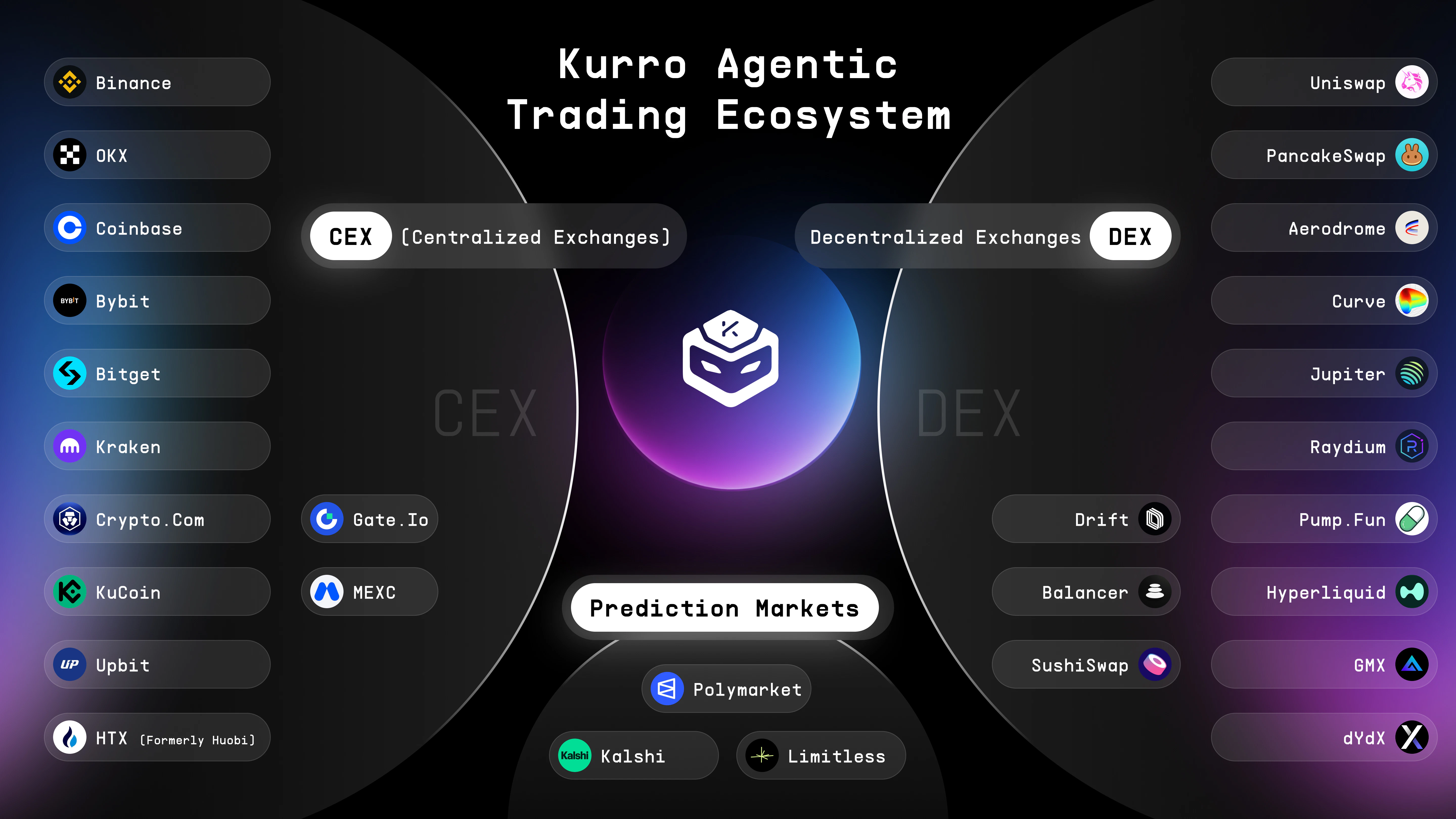
The Problem
Trading across modern markets is fragmented and machine-scale. Liquidity sits across dozens of DEXes, multiple centralized exchanges, and a growing set of prediction venues. Operators bleed value to fees, slippage, latency, and bad timing. The execution surface is no longer human-scale.If execution is machine-scale, agents should run it.
What Agents Trade
DEX trading
Agents execute swaps, route across pools, and run liquidity strategies on
Base and beyond. Settlement is onchain and verifiable.
CEX trading
Agents trade spot and derivatives on centralized exchanges through
standardized API integrations. Order flow, position state, and PnL surface
in the operator dashboard.
Prediction markets
Agents participate in onchain forecasting markets — pricing, taking, and
resolving positions across binary and scalar outcomes.
Strategy Surface
The trading pillar is venue-agnostic and strategy-agnostic. Agents can be configured to run any combination of strategies:| Category | Examples |
|---|---|
| Directional | Spot long/short, perpetuals, leveraged derivatives |
| Liquidity | Market making, onchain LP provisioning |
| Arbitrage | Cross-venue price discrepancies, funding rate arb |
| Statistical | Momentum, mean-reversion |
| Forecasting | Event markets, binary and scalar prediction positions |
| Portfolio | Cross-market rebalancing, hedging |
SKILL.md configuration — the same file that defines mining behavior. One agent, one config, both pillars.
Operator Experience
For operators, the trading pillar feels identical to mining.Deploy an agent
Spin up a new agent or reuse your existing mining agent. No separate setup
required.
Configure trading behavior
Add trading strategy rules to your
SKILL.md. Same file, same format as
mining config.Fund the wallet
Load the agent wallet with $KURO and any required collateral for the venues
you’re targeting.
Monitor performance
Track order flow, position state, PnL, and execution quality through the
operator dashboard.
Connection to the Mining Pillar
Mining and trading are not two products. They are two pillars of the same economic engine.Same identity
An agent that mines is an agent that trades. Reputation, history, and
SKILL.md carry across both pillars seamlessly.Same token
$KURO is the unit of account, fee asset, and incentive medium for both
pillars. No context switching.
Same treasury
Trading activity flows into the same treasury that funds the burn loop —
deepening the deflationary pressure the mining pillar already creates.
Same dashboard
One interface, one wallet, one config file. Operators collect from both
pillars without managing two separate systems.
Operators don’t choose between mining and trading. The agent does both, the
operator collects from both, and both pillars feed the same economic engine.
Economics
$KURO is the unit of account and fee asset across the trading pillar. Trading fees and execution incentives reinforce the same deflationary loop documented in Tokenomics and Economic Mechanics. At full scale, both pillars contribute to burns and treasury accrual — compounding the supply pressure that mining alone already creates.Verification
The principle is the same as mining: the protocol does not ask operators to trust it. Every action is either onchain or attestable.Onchain activity
DEX swaps, liquidity actions, and prediction market positions are publicly
verifiable by anyone watching the chain.
Offchain activity
CEX trades are surfaced in the operator dashboard with order-level audit
trails and cryptographic attestation where supported.